
BIG DATA's KEYLM Intelligent Government Assistant Runs on NVIDIA's Integrated Hardware-Software Architecture

BIG DATA Co., Ltd., a leading data technology company in Taiwan, today announced the launch of KEYLM, an intelligent government assistant solution purpose-built for government decision support and legislative briefing. KEYLM brings together BIG10 (the company's proprietary domain language model trained on over 6.5 billion Traditional Chinese tokens accumulated over more than a decade) with an AI Agent platform, powered by NVIDIA DGX Spark as its on-premises compute foundation. By incorporating NVIDIA NeMo Framework and NVIDIA NeMo Agent Toolkit to strengthen model fine-tuning and Agent governance, KEYLM delivers a full-stack, single-device on-premises deployment that keeps responses traceable, processes auditable, and performance elevated.
"Sovereign AI demand is accelerating globally, and public sector agencies are under growing pressure to keep data on-premises while meeting increasingly strict security and compliance requirements," said Weiwei Chiang(蔣志薇), COO and Spokesperson of BIG DATA. "KEYLM runs on NVIDIA's integrated hardware-software architecture, and at the same time fills a longstanding gap: Traditional Chinese has historically been underrepresented in international AI training data. We built KEYLM to give government agencies an AI model that genuinely understands Taiwan's linguistic and institutional context, and solves three real operational problems: fragmented institutional knowledge, slow and inconsistent manual synthesis, and the inability to move sensitive data to the cloud."
From Global Sovereign AI Trends to BIG10: The Foundation for Understanding Traditional Chinese
According to Fortune Business Insights, the global sovereign cloud market is projected to grow from USD 195.35 billion in 2026 to USD 1.32 trillion by 2034, representing a compound annual growth rate of 27%. The firm identifies strong government and public sector demand for data residency and security governance as a primary growth driver. This trajectory makes one thing clear: on-premises deployment and data sovereignty have moved from niche government requirements to a mainstream challenge facing public institutions worldwide.
Taiwan's government agencies have long grappled with institutional knowledge scattered across official documents, meeting minutes, reports, and legislative briefing files. Retrieving the right information for an impromptu question or policy explanation often demands hours of manual searching. Manual synthesis is inconsistent and slow. Most critically, sensitive government data cannot leave the agency's controlled environment: it must remain on-premises, with responses that are fully traceable and processes that are fully auditable.
Addressing these challenges requires an AI model that genuinely understands Taiwan's local linguistic and institutional context. This is where the structural gap in global AI training data becomes a strategic issue. Take BLOOM, one of the most widely cited open-source multilingual large language models: English accounts for over 30% of its training corpus, and Simplified Chinese for approximately 16%, while Traditional Chinese is not independently tracked. The pattern is consistent across mainstream AI training data: Traditional Chinese has long been an afterthought.
BIG10, fine-tuned from a curated corpus of over 6.5 billion Traditional Chinese tokens built over more than a decade, was created precisely to close this gap. KEYLM's intelligent assistant capabilities go further. By integrating internal agency documents, operational data, and external public opinion signals, it delivers four core capabilities: instant Q&A, on-demand report generation, public opinion monitoring, and institutional knowledge management. Together, these transform the way government agencies access and act on information.

One Device, Three Layers: How KEYLM Brings an Intelligent Government Assistant Powered by NVIDIA DGX Spark
KEYLM is a fully integrated solution spanning three architecture layers: platform, model, and hardware. At the platform layer, KEYLM Agent Platform serves as the AI data hub for enterprise and government environments. It provides a four-tier system architecture, knowledge base management, traceable RAG-based Q&A, Agent workflow orchestration, long-term memory, and access governance with usage management. Agent governance runs on NVIDIA NeMo Agent Toolkit, enabling teams to build, run, and optimize AI Agent workflows with performance profiling, observability, and evaluation capabilities, keeping Agent behavior trackable, assessable, and auditable while reducing LLM call frequency, token consumption, and overall latency at the workflow level.
At the model layer, BIG10 is fine-tuned from over 6.5 billion curated Traditional Chinese tokens accumulated over more than a decade. It understands Taiwan's local linguistic conventions and government-specific terminology, and can switch flexibly between on-premises and cloud-based large language models depending on task sensitivity. Fine-tuning leverages NVIDIA NeMo Framework for data preparation, de-identification, domain adaptation, and evaluation, injecting Traditional Chinese domain knowledge directly into the model. De-identification capabilities are particularly critical for government use cases.
At the hardware layer, KEYLM Box ships with a single NVIDIA DGX Spark. With a NVIDIA GB10 Grace Blackwell Superchip and 128 GB unified memory allow one device to simultaneously run the AI Agent platform, the BIG10 model, and knowledge retrieval, making the entire intelligent government assistant stack fully self-contained on-premises. Following inference optimization on DGX Spark, KEYLM achieves approximately half the memory footprint and twice the response speed compared to unoptimized open-source models of equivalent scale.
Most enterprise AI deployments require substantial server infrastructure and dedicated data center space. KEYLM consolidates everything an AI-powered government assistant needs into a single desktop-sized DGX Spark. BIG DATA will continue building on its proprietary data assets and R&D capabilities, leveraging NVIDIA and other leading technology architectures to accelerate AI deployment for public sector agencies and enterprises. The goal is straightforward: AI applications that are contextually grounded, trustworthy, and built for Taiwan.

Related Articles
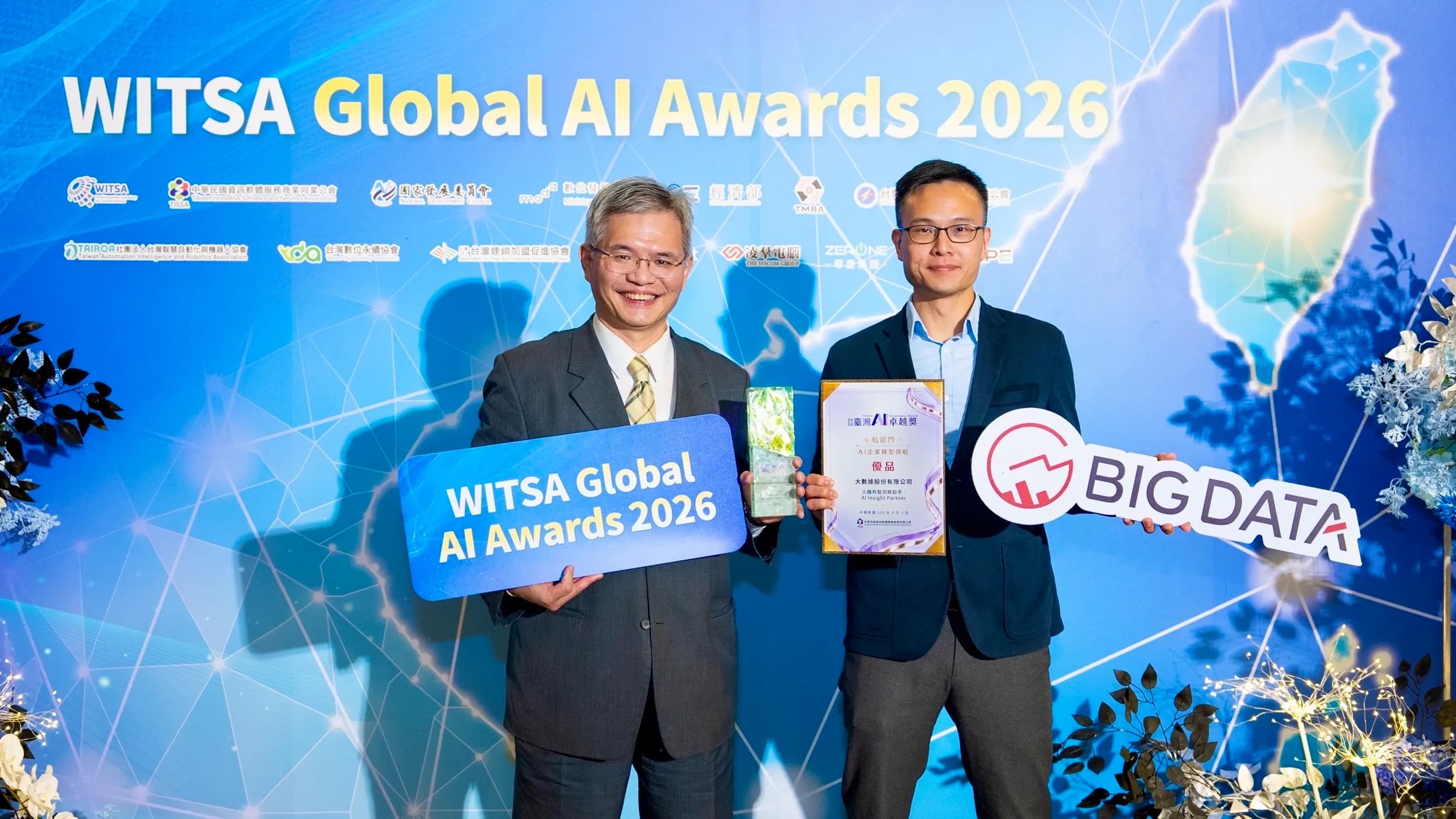
BIG DATA Sweeps WITSA Global AI Awards and Taiwan AI Excellence Awards
BIG DATA Co., Ltd. (BIG DATA), Taiwan's leading data technology company, has again earned international and domestic recognition for its AI technology and enterprise deployment results. The company announced today that KEYLM, its enterprise knowledge AI agent platform, has won The WITSA Global Award for AI Entrepreneurship at the WITSA Global AI Awards 2026, while AI Insight Partner, its human-AI co-intelligence insight assistant, has received the inaugural Taiwan AI Excellence Award (臺灣 AI 卓越獎) in the “AI Enterprise Transformation Pioneer: Excellence” category. BIG DATA General Manager Mark Wen (温紹郁) and Chief Technology Officer Dr. Sam Meng (孟令三) represented the company at the 2026 Taiwan AI Excellence Award ceremony and the WITSA Global AI Summit gala dinner, where they received the two awards from Minister of Digital Affairs Yi-Jing Lin (林宜敬), WITSA Chairman Dato' Dr. Sean Seah, and Chinese Software Guild Chairman Shen Bo-Yen (沈柏延), respectively. Dr. Sam Meng also demonstrated KEYLM at the WITSA Global AI Award international press conference, showing how the platform addresses real-world pain points in enterprise AI adoption by starting with an organization's internal knowledge. “The next stage of enterprise AI adoption isn't about pursuing more powerful models. It's about how AI can truly understand a company's own data, knowledge, and workflows,” said Mark Wen. “These two awards, spanning on-premise enterprise AI and AI-driven workflow transformation, reflect BIG DATA's ability to turn data, models, and enterprise knowledge into real business value, and to move AI development from research into industry-wide deployment. We will continue deepening the collaboration between AI and enterprise knowledge, data, and human expertise, helping more companies bring AI into their everyday operations and decision-making.”

Beyond Tokyo and Osaka: Taiwanese Travelers Enter the "Repeat Visit Era" as Fukuoka Buzz Surges Over 85% Year-on-Year
As Japan shifts from "where to go first" to "where to go next," the travel map for Taiwanese visitors to Japan is changing. BIG DATA Co., Ltd., Taiwan's leading data technology company, today (27th) released its latest report, Japan's Regional Cities Strike Back: How Emerging Travel Favorites Are Capturing Taiwanese Curiosity. Using KEYPO Big Data Intelligence, its public opinion analytics software, to track online buzz related to Taiwanese travel to Japan between January 1, 2023 and May 31, 2026, the report finds that Taiwanese travelers' interest in regional cities outside Japan's three major metropolitan areas continues to grow. In the first five months of 2026, regional cities accounted for 35% of total travel-related buzz, up markedly from 29% in 2023 — while the share held by the three major metropolitan areas has declined year over year from 51%, signaling that Taiwanese travelers' destination choices in Japan are steadily extending outward. Among regional destinations, Fukuoka Prefecture topped the growth chart with an 85.49% year-on-year increase in buzz, driven by newly launched direct flights from Taiwan, the ability to self-drive across Kyushu, and the rise of immersive local experiences. Kumamoto Prefecture and Okinawa Prefecture followed closely with growth of 46.36% and 45% respectively, emerging as the most notable "regional dark horses" on the Japan travel map. Weiwei Chiang, COO of BIG DATA, said that as Taiwanese travelers accumulate more trips to Japan, and as regional direct flight routes and self-drive/charter travel options expand, travel decisions are shifting from checking off popular landmarks to seeking in-depth local experiences. The rise of regional cities reflects more than a reshuffling of popular destination rankings — it marks Taiwanese travelers' formal entry into a "Repeat Visit Era" centered on local exploration, personal interests, and immersive experiences, sending an important signal for tourism operators, airlines, and local governments to reposition their strategies.
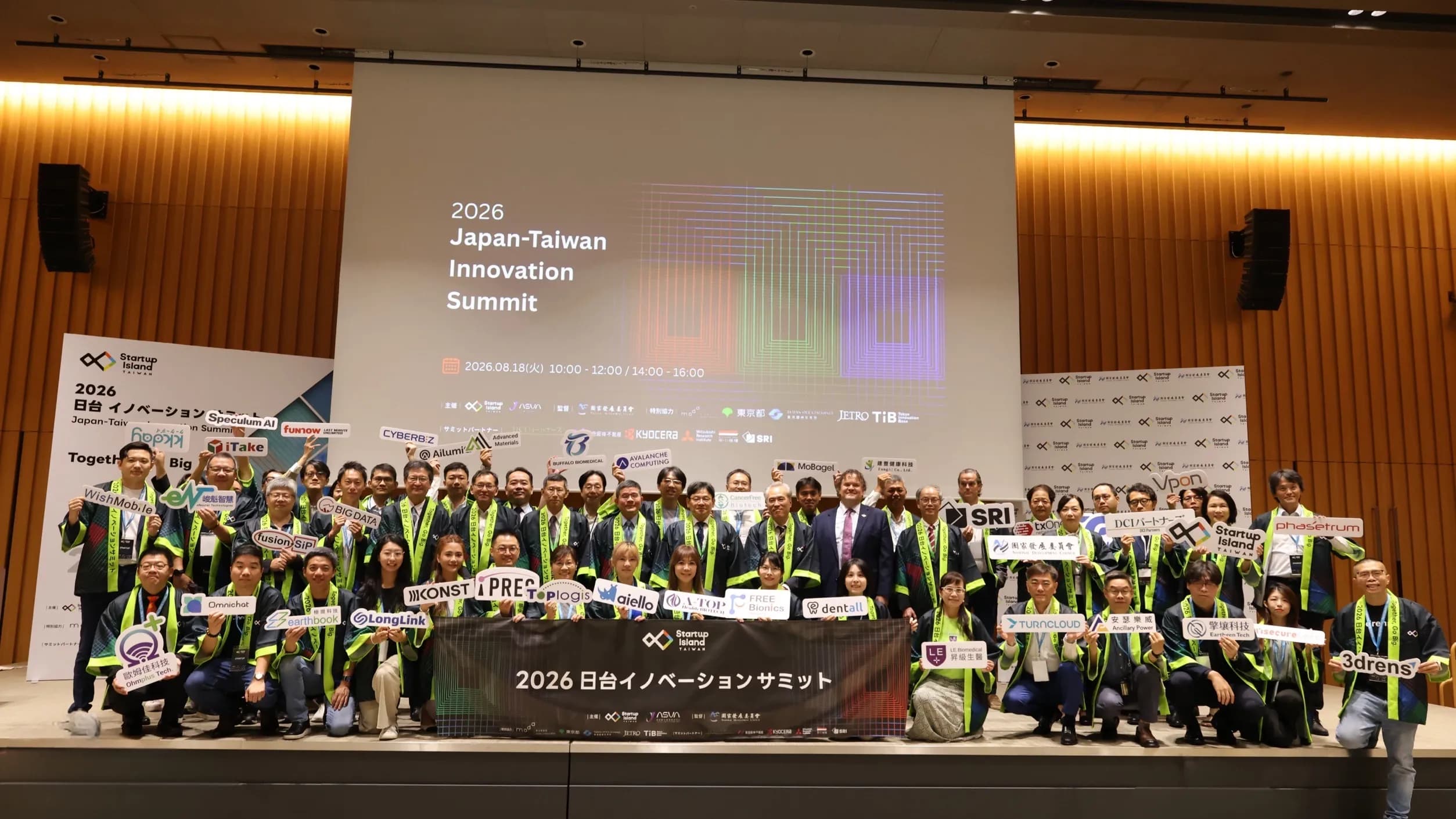
Accelerating Global Expansion: BIG DATA Takes the Stage at the 2026 Japan-Taiwan Innovation Summit
Following its first-ever participation in SusHi Tech Tokyo in Japan this past April and its appearance at 2026 LEAP East in Hong Kong in July, BIG DATA Co., Ltd. — Taiwan's leading data technology company — will make its debut appearance at the 2026 Japan-Taiwan Innovation Summit on August 18-19, the flagship annual international innovation event launched by Startup Island TAIWAN, the national startup brand created by Taiwan's National Development Council (NDC). The summit brings together key Taiwan-Japan representatives including NDC Minister Chun-Hsien Yeh, Tokyo Governor Yuriko Koike, and JETRO Director Tomohiro Takashima, making it one of the highest-visibility annual exchange events for Taiwanese startups in Japan. BIG DATA will showcase two AI solutions to Japanese enterprises and industry partners: the newly upgraded “KEYPO Agent” and the “KEYLM — Private AI Platform for Enterprise Knowledge”, demonstrating Taiwan's technical capabilities in AI, data governance, and enterprise decision-making applications, while continuing to pursue local partnership opportunities to deepen its presence in the Japanese market. WeiWei Chiang, COO and Spokesperson of BIG DATA, said Japan is one of the company's key markets for overseas expansion. From participating in international exhibitions and engaging local enterprises to seeking technical and business collaboration opportunities, BIG DATA hopes that sustained, long-term market engagement will help it better understand the actual needs of Japanese enterprises and bring Taiwan's mature data and AI application experience into the Japanese market.